The smarter E 2026: From Individual Components to System Solutions
Wind power, solar power, energy storage, and grid connectivity are converging. The trade show in Munich demonstrates why energy infrastructure must be approached holistically.

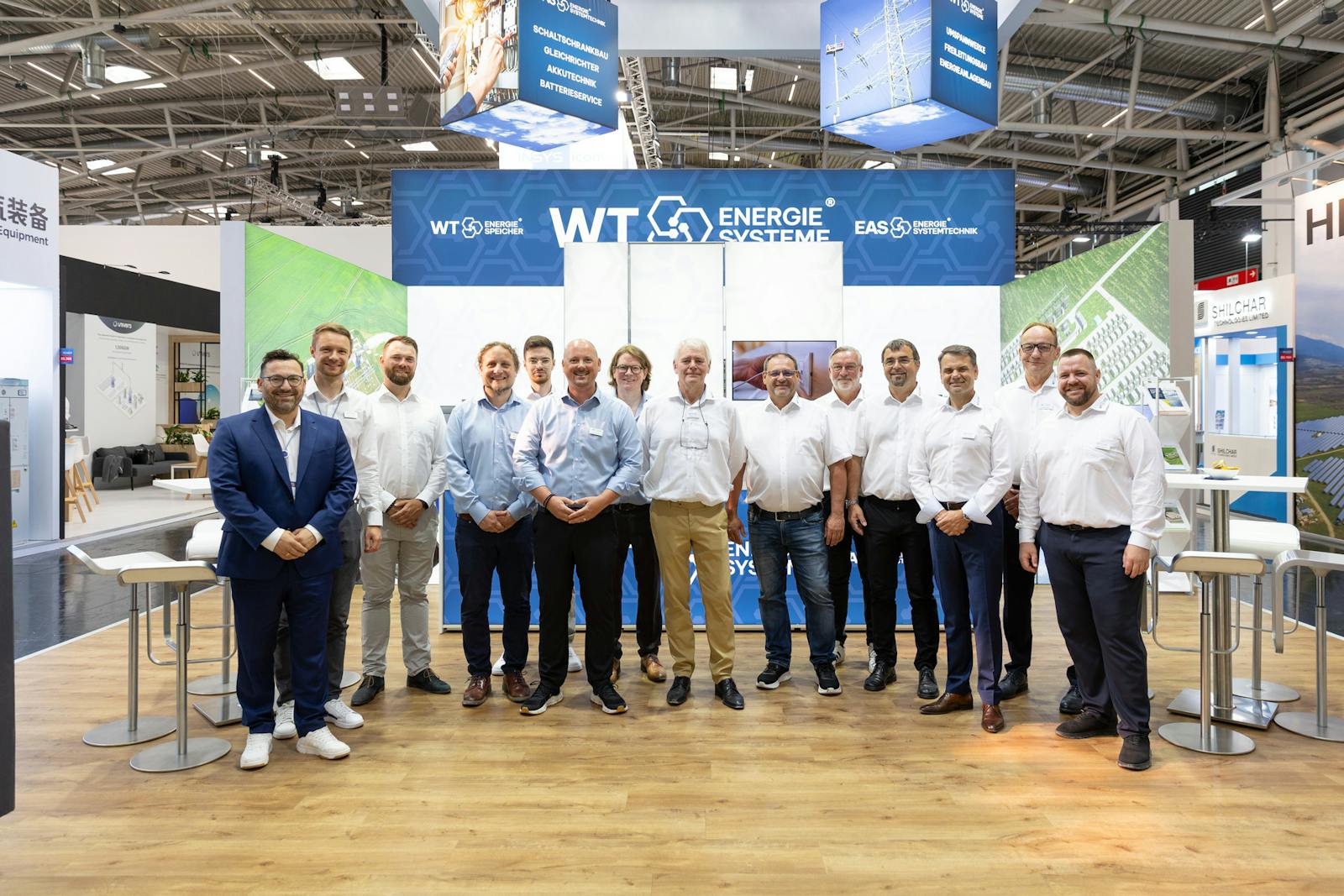
Three days at the trade fair in Munich, numerous discussions and a clear picture: the demands on the energy infrastructure are changing. Whilst in recent years the focus has primarily been on the expansion of wind and photovoltaic power, battery storage, high-performance grid connections and the extra-high-voltage level are increasingly taking centre stage.
It was precisely this development that shaped the discussions at The smarter E 2026.
As the WT Group, we presented our expertise this year for the first time as an even more integrated system. WT Energiesysteme, WT Energiespeicher and EAS Energiesystemtechnik cover different areas of energy infrastructure. From grid connection and battery storage to switchgear construction, projects can be viewed holistically and solutions implemented from a single source.
Our switch cabinet specialists from EAS Energiesystemtechnik were also present in Munich. Ronald Metzig describes the company’s focus as follows:
“It is particularly in smaller or highly bespoke projects that we can play to our strengths. Thanks to our flexibility and our range of services, we find solutions that are often not a priority for many large providers.”
Grid infrastructure is becoming a decisive factor
A key theme at the trade fair was the question of how renewable energy can be reliably integrated into the electricity grid in future. This is because, before wind and solar power can be fed into the grid, the appropriate grid connection is required.
This also increases the demands placed on the planning and implementation of substations. Robert Stefaniak describes the scope of these tasks:
“We take care of the planning for them, as well as all the necessary coordination with the energy suppliers, all stakeholders and the relevant authorities.”
The implementation of a substation therefore involves far more than just the technical installation itself. Permits, grid connections, coordination with authorities and the management of numerous project stakeholders are essential components of such an infrastructure project.
At the same time, the requirements for voltage levels are shifting. More and more projects are operating in power ranges of 500 MW and above. Such power levels can no longer be integrated via distribution networks alone. As a result, the 380 kV level is becoming increasingly important.
Henriko Peplow describes the role of the extra-high-voltage level as follows:
“The 380 kV substations can be thought of as motorways for us here in the Federal Republic of Germany. They are a vital component in the success of the energy transition.”
In order to systematically expand its expertise in this area, WT Energiesysteme has established its own 380 kV hub in Rostock. This is where know-how for extra-high-voltage projects is pooled. The aim is to offer EPC services at this voltage level as well – ranging from concept development and planning, through coordination with grid operators, to turnkey implementation.
The first projects demonstrate that this development is already taking concrete shape. Two 380 kV substations are currently under construction in the 50Hertz network area. The design phase has been completed, and the key components are already in production.
For Henriko Peplow, a key challenge in such projects lies in coordinating all parties involved:
“These substations must work in close collaboration with energy generators and the grid operators responsible for security of supply, communicating and coordinating the systems with one another so that stability and security of supply remain guaranteed even when new generation plants are integrated.”
Battery storage is gaining in importance
Alongside grid infrastructure, battery storage was one of the defining themes of the trade fair. In future, renewable energy is not only to be generated but also made available in a more flexible manner. Battery storage systems can absorb surplus energy, release it at a later time and thus contribute to stabilising the energy system.
By expanding our portfolio to include the WT Energy Storage division, we have responded to this development and strengthened our expertise across the energy infrastructure.
Heiko Richter describes a key challenge facing the current market:
“At present, demand for grid connections significantly exceeds the grid’s capacity.”
In many places, the high demand for battery storage systems, renewable energy generation facilities and new large-scale consumers such as data centres is coming up against limited grid capacity. As a result, grid connection is increasingly becoming a decisive factor in the successful implementation of new projects.
This is precisely where the various areas of expertise within the WT Group come together. Grid connection and battery storage can be considered as a single integrated solution. Planning, implementation and the coordination of interfaces are all provided from a single source.
Taking a holistic approach to energy infrastructure
Discussions at The smarter E 2026 have thus confirmed a trend evident across the entire sector: energy infrastructure can increasingly no longer be viewed in isolation.
Wind and photovoltaic power, battery storage, substations and extra-high-voltage grids are directly interlinked. At the same time, the demands on planning, grid connection, digitalisation and coordination between the various project stakeholders are increasing.
This is precisely why the WT Group presented its diverse areas of expertise together at a single stand at the exhibition. WT Energiesysteme, WT Energiespeicher and EAS Energiesystemtechnik cover various sectors across the energy infrastructure spectrum.
The smarter E 2026 demonstrated just how dynamically the market is developing and the challenges associated with the increasing scale and complexity of projects.
For us, this is a clear endorsement of our approach: energy infrastructure must be considered holistically. Not as the interaction of individual components, but as an integrated system comprising grid connection, substations, battery storage and smart infrastructure.
Many thanks to all visitors, customers, partners and colleagues for the numerous discussions and professional exchanges at The smarter E 2026.