WindEnergy Hamburg 2026: Four Days, Many Perspectives
Find out which developments in wind power, solar power, battery storage, and grid infrastructure shaped the discussions.

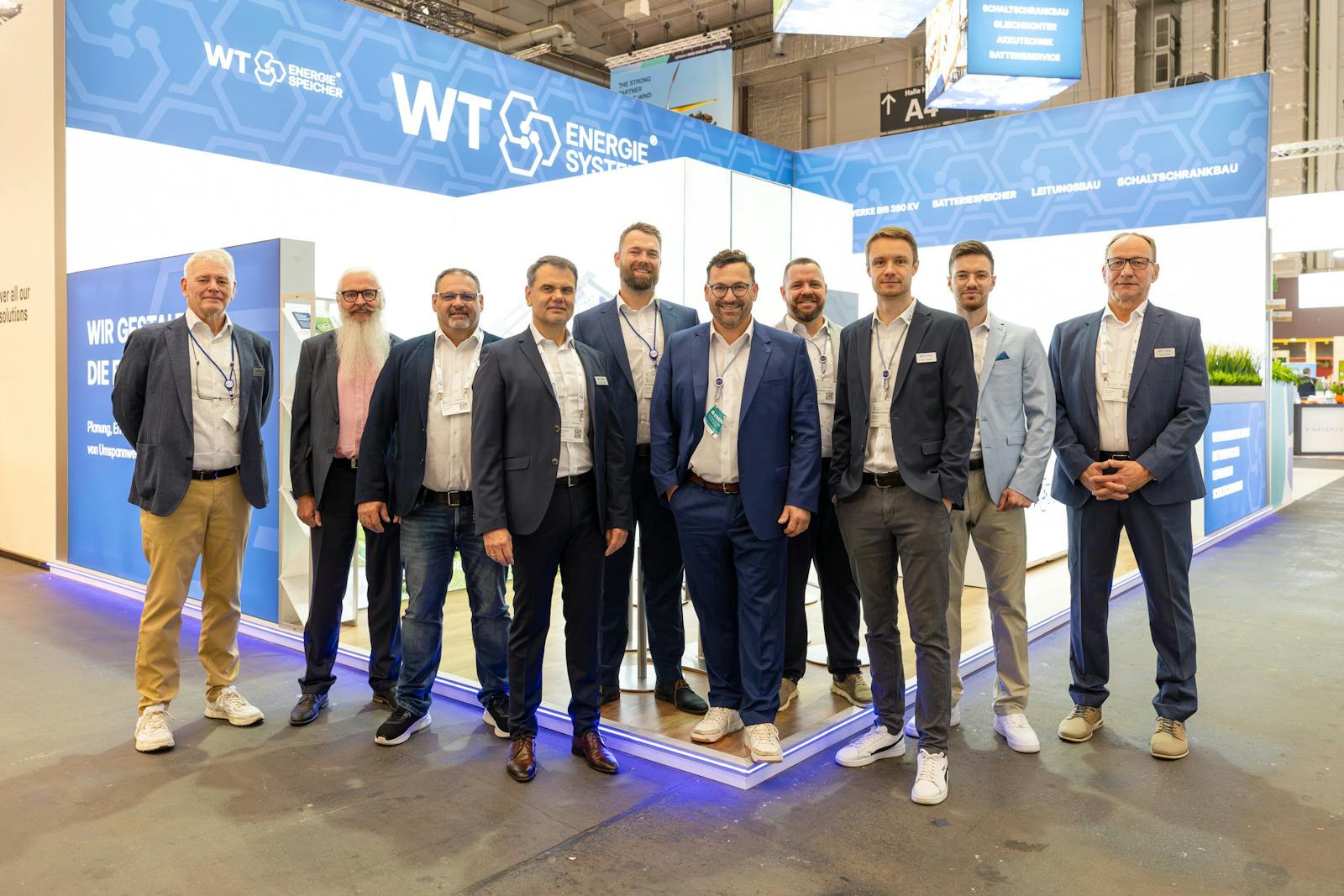
Four days at WindEnergy Hamburg 2026 are behind us. We came to Hamburg primarily to find out one thing: What is the mood among our customers? How do they view the current situation and their future projects?
The result genuinely surprised us. Despite some uncertainty, our customers are very forward looking. They view the projects in their pipelines with a certain degree of confidence and remain clearly focused on the future.
The uncertainty that nevertheless remains is primarily related to the political framework conditions. At the same time, the conversations at the trade fair showed how strongly the topics within the industry continue to develop and connect with one another.
380 kV: Substations are becoming a central part of project planning
Henriko Peplow set a technical focus with his “380 kV compact” series. His presentation addressed the current challenges in planning and implementing substations up to 380 kV.
The focus included rising connection capacities, battery storage systems, expandability, digitalization and the question of why a substation should be considered part of the overall project from the very beginning.
At the same time, another development is becoming apparent: concerns are increasing that the existing grid connections at the 110 kV level will not be sufficient for the planned capacities. The discussions made it clear that within just a few months, the focus has shifted more strongly towards 380 kV.
This confirms our strategic decision to continue expanding and developing our 380 kV division and to equip our hub in Rostock accordingly.
The first orders have already allowed us to gain experience and demonstrate the requirements associated with the increasing complexity of the projects:
“Bringing together investors who want to invest in a wide variety of systems and at different scales. Connecting and linking them, looking at the entire topic both electrically and legally, so that the grid connections (…) can also be implemented accordingly,” says Henriko Peplow.
Battery storage systems are increasingly being considered together with wind and PV
Battery storage systems were also a defining topic at the trade fair. WindEnergy Hamburg is primarily a trade fair for wind technology. Nevertheless, the discussions on site clearly showed how present the topic has become.
Heiko Richter and Reiko Sänger held numerous discussions about storage solutions. These included both co locations with wind farms and PV parks as well as stand alone storage systems.
“Demand, or rather the discussions, remain unabated and continue to be at a very high level,” says Heiko Richter.
At the same time, the perspective on storage projects is changing. In addition to short term financial effects, long term aspects are increasingly coming into focus. These include operating life, operating costs and the availability of spare parts.
“There is a very strong change in thinking. Not only in terms of CapEx, but also with regard to operating costs.”
This long term perspective also plays a role in the selection of suppliers. Many customers pay attention to ensuring that important spare parts are available in Germany. If desired, the storage of important components can also be part of an order with us.
For WT Energiespeicher, the focus is increasingly on gaining experience from the first projects and continuing to build up the business division.
“We are pleased that we have now received the orders for the first projects and can now move them into implementation in order to gain experience from them and continue building up our team.”
A market that continues to look ahead
One topic that repeatedly came up in the discussions was the political framework conditions. Many of our customers are convinced that storage systems can make a decisive contribution to solving the current challenges. Accordingly, there is also a clear expectation of policymakers: listen to companies with their expertise and experience and create the appropriate framework conditions so that the expansion of renewable energies and the targets set for 2040 can be achieved.
For us, WindEnergy Hamburg showed one thing above all: The topics of the energy transition are growing together. Wind, photovoltaics, battery storage and grid infrastructure are increasingly being considered together.
The outlook remains positive. Dietmar Tietz sums up his trade fair conclusion:
“Optimism still prevails, combined with the hope that there will actually be cooperation between policymakers and the business community.”
Thank you to everyone involved and to our customers for the numerous discussions and the open exchange at WindEnergy Hamburg 2026.